Ductwork
Ductwork sealing, repair and replacement
Leaky, sagging or mildewed ducts waste the cooling you paid for. Mr. Chill seals, repairs and replaces them, and treats them with antimicrobial where needed.
Chapter 01
Where the cold air goes before it reaches you
A duct system is the part of a heating and cooling setup nobody sees, which is why it fails quietly. Joints come apart where the flex meets the plenum. Mastic dries and cracks. A run sags in a hot attic until it pinches, or a section gets crushed when someone stores boxes on it. Every one of those leaks pushes conditioned air into the attic, and pulls attic air back into the system.
In a Tomball summer an attic gets very hot, so the penalty shows up fast: rooms at the end of a run that never catch up, an AC that runs long and still trails the thermostat, and a power bill that seems high for the size of the house. Add Houston-area humidity and a cold duct running through damp air, and the other classic problem shows up: sweating, wet insulation and mildew growing on the duct itself.
Those two items, air leaks and duct mildew, are both on the cooling tune-up checklist for a reason. They are the first things a technician checks once the equipment itself is cleared.
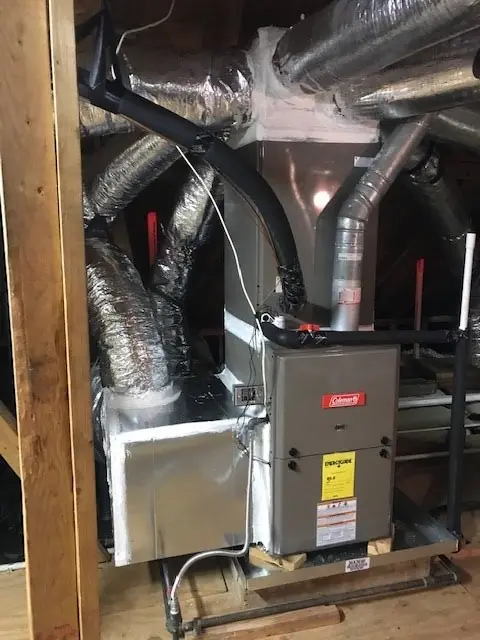
A Coleman air handler in an attic with flex ductwork branching off the plenum
Seal it, patch it, or start over
The work falls into three jobs, and the right one depends on what the technician finds in the attic or crawlspace. Duct sealing closes the leaks in a system that is otherwise sound: connections at the plenum and the boots, seams, and the joints at each register. Duct repair fixes a specific failure, like a torn run, a collapsed section or a disconnected branch. Duct replacement is for a system that is past patching, where the insulation is soaked or the flex has broken down.
Mr. Chill does all three, plus antimicrobial ductwork treatment for systems where mildew has taken hold. The photo of the Coleman air handler in an attic shows what the technician is actually looking at: the plenum on top of the unit, flex runs branching off it, and every connection a place air can escape.
Replacement is the one job we do not recommend lightly. Our technicians walk you through what they see, with the sealing and repair options on the table first, before a full replacement comes up.
Chapter 03
Far bedrooms and the single trunk line
Manufactured and modular homes put the most strain on ductwork. A long, narrow floor plan is often fed by a single trunk line down the middle, so the far bedrooms get whatever pressure is left at the end of the run. If the back bedroom of your Magnolia or Conroe home never cools the way the living room does, that single trunk is usually why.
Sealing the trunk and its branches is the first step, and many of these homes also benefit from added return-air vents, so the air has somewhere to go when the bedroom doors are shut. Mr. Chill has specialised in this work for years, across Greater Houston and well beyond. The full picture is on the manufactured homes page.
After any duct job, the next place to look is the filter and the blower, since a clean duct and a loaded filter will not get along. The spring cooling tune-up checklist includes duct mildew and air leaks, so a Chill Club member gets a second look at the ducts every year instead of waiting for the next hot week.
Mr. Chill. Licensed and insured, TACLB27361E. Call (832) 698-4273.